Friday, October 7, 2011

Anime/Manga Review: Yu Yu Hakusho


Author:  Yoshihiro Togashi

Genre:  action, fighting

Target Age:  Teen

Content:  violence, fantasy fighting, some language, some scary scenes and supernatural elements

Episodes/Volumes:  112 episodes, 19 volumes

Story:  Yu Yu Hakusho tells the story of Yusuke Urameshi, a high school delinquent.  Though he has a reputation as a troublemaker, the single act of pushing a child out of traffic gets him run over by a car.  On the verge of death, he meets Botan, the young and beautiful Grim Reaper who rides a broomstick.  She tells him that Koenma, the son of the king of the underworld, has given Yusuke the opportunity for survival; if Yusuke becomes a "spirit detective" he can eventually be returned to life.  Yusuke obviously takes the offer.

After his revival, Yusuke continues working for Koenma.  In the process he befriends his rival Kuwabara, another delinquent at his school.  After being sent on missions to capture them, he later befriends the demon criminals Kurama and Hiei, who join him to earn a pardon from Koenma.  Despite the circumstances of their meeting and the underlying animosity, the four quickly develop what the Japanese call "nakama" (a deep sense of camaraderie beyond friendship, a good Western equivalent being The Three Musketeers).  They express disgust and shock whenever enemies betray each other.  The character dynamics and rivalry can lead to some comedic moments, particularly between Kuwabara and Hiei.  Hiei often implies that he would betray the team if it were in his best interests, but when the opportunity arrives, it seems the "power of friendship" gets the better of him.  (I know that sounds goofy, but it makes sense in context.)

The anime and manga follow several story lines, but they are all just excuses for fighting.  Three of them feature tournaments, two on Earth and one in the Demon Realm.  The battles are flashy, with very little actual hand to hand combat.  Most of it utilizes energy manipulation, similar to the Dragonball series.  Typical of the genre in the 1990s, it may take several episodes to complete a single battle, and there is much dialogue during the actual fight.  The animation and artwork may seem goofy at times, especially during the comedic moments.

Voice:  The Japanese voice acting is good.  Opinions are mixed on the English dub.  Some fans like the English dub, others don't.  The English dialogue has many discrepancies with the English subtitles, often showing completely different lines of dialogue.  However, one reason the English dub is so popular is because it is often more entertaining than the Japanese dialogue and tends to evoke more laughs.  Viewers should sample both the subtitled and dubbed versions before deciding which one they prefer.

On a humorous side note, the Portuguese dub featured the character Kurama as a girl.  Granted, he does have a bishie look that is easy to confuse for female, and some girls in the story even confuse him for another character's girlfriend.  He is a demonic horticulturist, so his weapons of choice are plant based.  His favorite weapon is a rose whip.  However, a scene where Kurama had no shirt on revealed he was a boy, and the studio had to redo all his lines.

Music:
opening:  "Smile Bomb" by Matsuko Mawatari

ending:  "Homework never Ends" by Matsuko Mawatari

ending:  "Sayanora Bye Bye" by Matsuko Mawatari

ending:  "Daydream Generation" by Matsuko Mawatari

ending:  "Kissing the Unbalanced" by Hiro Takahashi

ending:  "The Sun Is Shining Again" by Hiro Takahashi

Anime Review: Samurai 7


Genre:  steampunk, action, drama

Target Age:  Teen

Content:  sci-fi violence, some language

Episodes:  26


Story:  Samurai 7 is a futuristic/historical revision of Akira Kurosawa's classic epic Seven Samurai.

The premise follows the basic story line of the movie, but places the traditional samurai within a science fiction themed environment.  A few peasants seek out seven samurai to protect their village from bandits, but all they can pay the samurai with is rice.  The basic characterizations of the samurai are the same, though liberties are taken for the sake of the story.  For example, in the opening credit sequence, the samurai's names are written in katakana (Japanese phonetic script for foreign words and names) to illustrate the "foreign" world they live in.  One samurai, Gorobei, was designed to appear with African ancestry.  Kambei, the de facto leader, was originally intended this way, but redesigns produced a character who appeared of Southeast Asian origin.  Katshiro has a traditional Japanese appearance, while the others are a tad ambiguous (which is quite common in anime).

The story begins with a reference to the war that led to the present political strife and socioeconomic restructuring.  If the viewers were unaware of the sci-fi theme, they may be surprised to see a samurai using only his sword to take out an airship in midair!  And mecha!  And lots of explosions!  The bandits, known as the Nobusari, are veterans of this war who are left without masters and jobs.  The people of Kanna village send their water priestess, Kirara, and another villager, Rikichi to the city to find seven samurai willing to protect their village for rice.  Needless to say, their first efforts are unsuccessful.  The samurai either say no and yell at them for being so foolish, or eat the rice and then say no.  When Kirara finally meets Kambei, she just knows he's the one.  At first he refuses to help and states that he's lost every battle he's ever fought.  Eventually, Kirara is forced to take a drastic measure (which involves nearly getting herself killed) to convince him to help her.  After he agrees to help, the other six samurai decide to join because they are so intrigued by Kambei.  The samurai quickly earn the ire of Ukyo, the spoiled son of a rich merchant.  he makes a point of challenging the samurai and claiming Kirara as his own.  He begins as a sheltered moron who thinks he can take whatever he wants, but he is more than meets the eye, to everyone's misfortune, including his own father.

The samurai themselves have their own individual quirks, which sometimes causes strife among them, and the character dynamics drive much of the story.  Many of the villagers do not trust the samurai at first, as the Nobusari were samurai, now transformed into machines and mecha.  The village appears as a typical farming community of feudal Japan, whereas the city is pure steampunk.  It can feel a little strange seeing these two worlds coexisting, and even the peasants show awe when they see the city for the first time.

Since it is a time of war, there is much tragedy to go around.  The villagers are terrified of the bandits not only because the bandits steal their food, but also kidnap their women, and the reason behind it, revealed later in the series, is quite unsettling.  Rikichi is especially on edge because his own wife was taken by the bandits before the story began.  Not everyone, samurai included, walks away from the battle unscathed, and not everyone will see the end of the war.

Voice:  Most of the English voices are good, but a few of the peasants' voices miss the mark.  Ukyo's voice helps mark him as an annoying brat, which makes his ulterior motives that much more sinister when they are revealed.  The show can be enjoyed in either language.

Music:
opening -- "Unlimited" by nanase Aikawa
closing -- "Fuhen' by Rin'

The opening song "Unlimited" is a contemporary pop song, while the closing song "Fuhen" is slower and more traditional in style.

Recommendation:  Anyone who likes samurai and battle sequences, if he or she is willing to accept the technology angle.

Tuesday, May 17, 2011

Anime Review: Ghost in the Shell Stand Alone Complex


Genre:  action, sci-fi, cyberpunk

Target age:  Older Teen

Content:  Sci-fi violence, gun violence, some adult language, brief non-sexual nudity of an android in a factory in one episode

Episodes:  26

Story:  Ghost in the Shell Stand Alone Complex takes place in Japan in the year 2030.  While the series follows a story arc, known as "complex" episodes, there are breather episodes that follow a "stand alone" storyline.  In the world of Ghost in the Shell, it is commonplace for humans to be cyberdized; in other words, they may have their brains augmented with cybernetic implants.  Sometimes they may choose to have other body parts, or even their whole bodies, replaced with cybernetic parts.  They can access the internet with cyberbrains, or even communicate with each other over the net, which functions like telepathy.

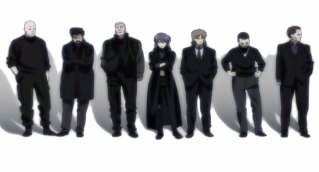
The story is driven by the exploits of Section 9, a covert police force that does not officially exist.  All members have cyberbrains, though their levels of cyberdization vary.  The seven most important members are Kusanagi (known by her comrades as the Major), Batou, Togusa, Pazu, Saito, Borma, and Ishikawa; and each has a field that they specialize in.  For example, Ishikawa specializes in information and surveillance, while Saito specializes in sniping.  They are led by Aramaki, who does mission briefings and gives them their orders.  Though the episodes do feature all of the above eight, the episodes tend to focus mostly on Kusanagi.  A few of the others occasionally have episodes centered around them.  Though the Major is the only woman on the team, the men always give her due respect and follow her orders without question.  They are all very protective of each other, especially towards Togusa because his entire body, excluding his cyberbrain, is still flesh and blood, and he has a wife and children.

The team is supplemented by artificially intelligent tanks called Tachikoma.  Though they are machines, they can speak with each other and with the members of Section 9.  An ongoing subplot is concern over whether the Tachikoma are developing self awareness.  Batou in particular is very fond of the Tachikoma.  They speak with childlike voices and often inspire an "awwww" response.

The plot of Stand Alone Complex can get difficult to follow if the viewer does not pay attention.  Blink and you'll miss it.  There is much intrigue involving politicians, terrorists, and dishonest medical corporations.  Eventually, not even Section 9 is safe from politicians' ulterior motives.  The characters sometimes talk about the meaning of existence, what makes one human, and the nature of the "ghost."  Most of these center around the Tachikoma or the Major.  The Major's situation is especially powerful because she was completely cyberdized at a very young age to survive a terrible accident.  Learning to control her cyberbody was a source of emotional pain for her.  People who are easily turned offed by existential conversation may not be interested in the series, but they may find themselves intrigued by the storylines if they give the show a chance.

There is also a season two known as Ghost in the Shell Stand Alone Complex 2nd Gig.  Season two is 26 episodes long and delves more into the Major's history, as well as her coincidental connection to a terrorist group known as the Individual Eleven.

Voice:  Both the Japanese and English voices and dialogue are very good.  Some anime fans may recognize the Major's English voice actress Mary Elizabeth McGlynn, who has an extensive list of anime and video games she has been featured in, as well as performing on video game soundtracks.

Music:
  • Season One opening theme "Inner Universe" by Origa
  • Season Two opening theme "Rise" by Origa
  • Season One closing theme "Lithium Flower" by Scott Matthew
  • Season Two closing theme "Living Inside the Shell" by Steve Conte and Shanti Snyder
Another Yoko Kanno masterpiece.  Surprisingly, none of the music is in Japanese.  A lot of the music is instrumental.  Songs with lyrics are in English, Russian, Latin, or gibberish.  Origa is a Russian singer who is very popular in Japan; she performs in both Russian and English.  Yoko Kanno performs some of the songs herself under the name Gabriela Robin.  The soundtrack is varied with multiple musical styles, from R&B to rock and much in between.  Some songs, like "Inner Universe" are beautiful ballads, whereas others like "Lithium Flower" make the listener want to dance, or at least tap his feet.  Some, like "Stamina Rose," are easy flowing, while others, like "Get9," are fast and hard.

Recommendation:  If you don't mind a show that makes you think about life and the nature of humanity versus machine, then Ghost in the Shell may be for you.  You have to be willing to pay attention to the plot, or something that happens in later episodes will make little sense.  Be prepared for a few moments that may make you squirm.

Anime Review: Cowboy Bebop


Genre:  action, sci-fi

Target age:  Teen

Content:  Lots of sci-fi action with guns and spaceships, some adult language

Episodes:  26

Story:  Cowboy Bebop is mostly episodic in nature, meaning that most of the episodes are stand alone and have little to do with each other storywise, though this changes towards the end of the series.  The setting is in the far future, where space travel is common, though there are no aliens in the entire series (except for the food).  The show is about a small group of bounty hunters and their comedic quest for the next job, and something edible.  The entire series is confined to the Terran solar system.  The show carries the atmosphere of the Wild West in space, hence the "Cowboy" in the title.  There's even a television show that caters to bounty hunters whose theme song is a banjo solo.  "Bebop" references the name of the spaceship.  The story is mostly action based, but there is also some situational comedy at the characters' expense.

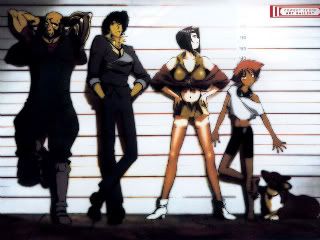
The story focuses on four bounty hunters and their dog.  Yes, even the dog.  The de facto leaders of the group are Spike Spiegel and his pal Jet Black.  Jet takes his job seriously, but is a tad philosophical.  Spike is more practical.  (The most important lesson he's ever learned is "don't leave food in the fridge" and for good reason.  An entire episode is based on this point.)  He's a former mobster and a highly skilled Jeet Kune Do practitioner.  His history is a source of personal torment for him.  Along the way they pick up Faye Valentine, an amnesiac woman who takes up bounty hunting and gambling to pay off an unbelievably huge medical bill for having spent 50 years in cryostasis.  She has difficulty putting faith in others and often tries to scam her way out of bad situations, though circumstances usually force her to rely on the team quite frequently.  Then there is Edward Wong Hau Pepulu Tivruskii 4th, a tween girl who is also a computer genius.  She is goofy and somewhat dysfunctional, but her computer skills are invaluable, as she's a top notch hacker.  The dog is a Welsh Corgi named Ein, short for Einstein.  His role is mostly to hang around in the background, but he comes off as the most intelligent character on the show.  After all, he was the only one capable of stopping a train once.  He is referred to as a "data dog," but the story never explains what that means.

Voices:  Both the Japanese and English dubbing are well done.  The English voices fit most of the characters, and the dialogue follows the subtitles closely.  The series is easy to enjoy in either language.

Music: 
  • Opening Theme:  "Tank" by The Seatbelts
  • Closing Theme:  "The Real Folk Blues" by the Seatbelts featuring Mai Yamane
The music was composed by Yoko Kanno.  She is highly regarded in the anime community, and anything written by her is almost guaranteed to be a smash hit.  Her music is very ambient and fits the style of the series very well.  The opening theme is a fast paced jazzy tune with a saxophone solo and even some bongos, but is also contemporary.  The closing theme is also jazzy, but is slow and moody.

Recommendation:  Cowboy Bebop is one of the most popular anime ever.  Almost anyone who watches it is sure to enjoy it.

Friday, January 21, 2011

Happy New Year!

The anime club celebrated the New Year once everyone got home from their holiday trips.  We had to get a little creative with our food.  Here is sushi made from Swiss Rolls and gummi bears.

Photobucket

One of our members cosplayed as Alois from Black Butler, then went for a casual walk through the library.

Photobucket


We even played Pin the Geass on Lelouch.  You have to aim for the left eye.  Lelouch is the main character of the anime Code Geass, and the Geass is a special power in his left eye that gives him the ability to plant hidden commands into people's minds, and they can never disobey.


Here's to the new year, and hopes for many more fun times.

Wednesday, August 18, 2010

Ninja in Our Midst

The anime club indulged its creative side with face masks and Naruto headbands.

Photobucket

Patti checks in on us while one of the ninja-to-be strikes a pose.

Photobucket

Club members came up with various designs for their masks. Most of them were anime themed, of course.

Photobucket

The hidden Waterfall ninja finally shows himself!

Photobucket

There is also a Mist ninja among us.

Photobucket

As for me, no one knows I am a former Leaf ninja of the Akatsuki. Will the ninja discover my latest dastardly plan? Time will tell.

Thursday, August 12, 2010

A Gift, A Weird Question, and Cleaning Up

One of the anime club regulars is quite the creative one. She made this little necklace just for me. Meet Grimmjow Jaeggerjaques, the Sexta Espada from the manga and anime Bleach by Tite Kubo.

Photobucket

I was recently introduced to an anime called Kuroshitsuji (Black Butler). The show features a strange character named Grell who is . . . special. ChibiPenguinChan of Youtube graciously allowed me to pose the question, "Does Grell creep you out?"


One must admit, any group meeting where food meets "youngins" is bound to result in a mess. Thankfully, the anime club likes to clean up, and make a show of it, too.